How is an alpaca duvet made? From fleece to finished product
Warm sunbeams break through the window, shining directly on your face. You slowly open your eyes, only to close them again. Just a little longer in bed – you think. You take a deep breath and snuggle under your favorite alpaca wool duvet – soft, fluffy, and light. A few minutes pass... maybe a little more, but you get up feeling great – full of energy, well-rested, and ready to go. This is thanks, in part, to a high-quality duvet made from natural materials. Find out how it’s made and what makes it so comfortable!
Meticulous production of the alpaca duvet step by step
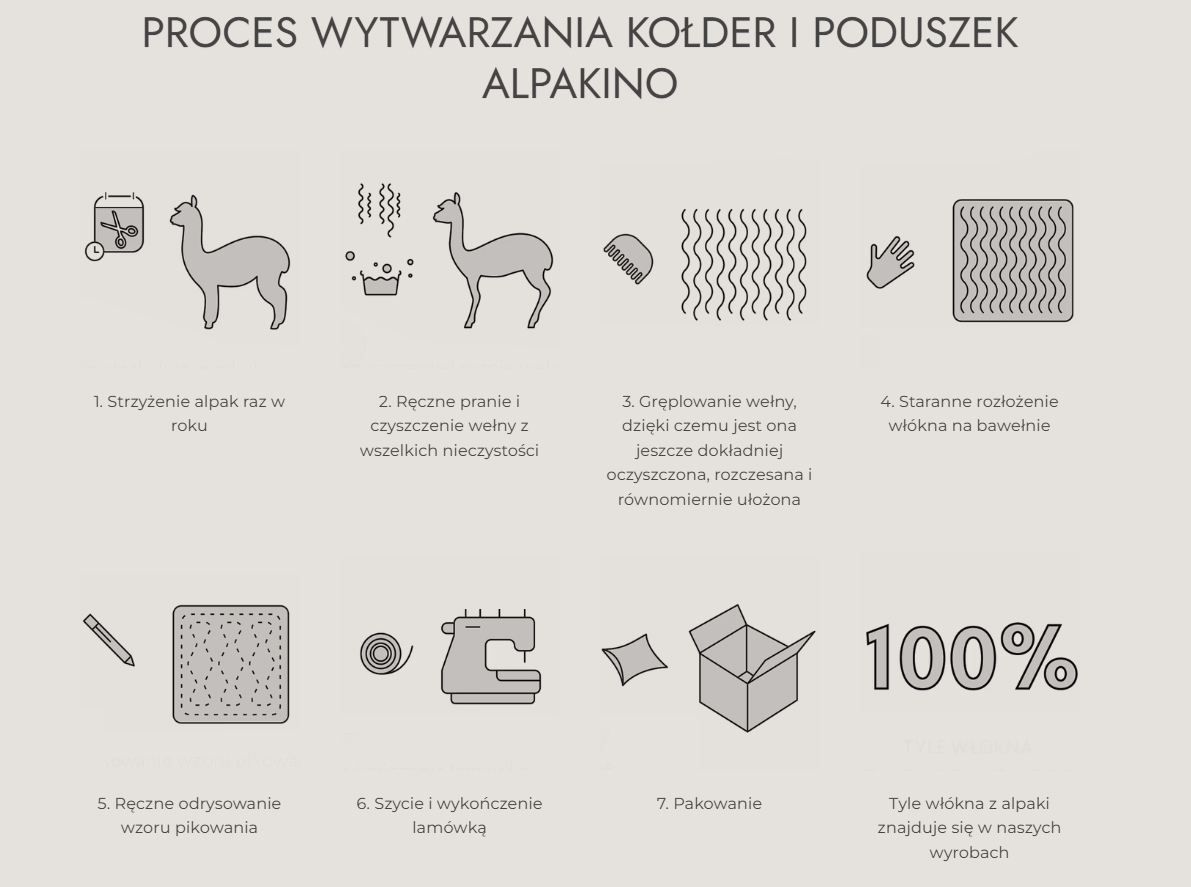
The process of creating an alpaca duvet in our workshop consists of seven carefully planned stages. Each of them is immensely important and cannot be skipped. At the same time, we carry out all steps with care to bring out and preserve the most important features of the noble raw material, which is alpaca fleece. See how exactly we prepare our duvets!
- Shearing alpacas – once a year
Alpacas are shorn once a year, most often in spring – April or May, when the cold weather ends. This is done using a specialized shearing machine. We place the animal in a safe lying position, which makes the process quick and comfortable for it. This procedure is also a moment for a comprehensive health check of the alpacas. At this time, we also: trim their nails, file their teeth, carefully examine their skin, and assess their condition. After shearing, the fleece is sorted. Not every part of the fiber is suitable for further processing, so only the best fragments are selected: the cleanest, longest, and softest.

- Hand washing and cleaning of wool
Raw alpaca fiber requires very gentle cleaning. Wool cannot be machine washed, as it easily felts under the influence of temperature and mechanical movement. Therefore, we hand wash it in small batches. The process involves gently submerging the fiber in water, very lightly agitating the fleece, and repeatedly changing the water. This is repeated until the water remains completely clean. Then, the wool is naturally dried in a well-ventilated area – away from heat sources, such as radiators. This is a time-consuming process, but it allows us to preserve the natural structure and softness of the alpaca fiber.
- Carding the wool
After drying, the fiber undergoes a carding process. This is the mechanical combing of wool using a large carding machine. During this procedure:
- the wool is loosened,
- small impurities are removed,
- the fibers are aligned in one direction.
As a result of this process, we obtain soft, fluffy sheets of alpaca wool, which have a uniform structure and are ready for further forming of the duvet filling.
- Careful spreading of fiber on cotton
The finished sheets of alpaca fleece are hand-spread onto cotton fabric, which forms the duvet cover. This stage requires great precision, as the fiber must be spread evenly. The filling should have the same thickness over the entire surface, as this determines the subsequent comfort of using the duvet. Manual spreading helps maintain the lightness, fluffiness, and natural resilience of the alpaca fiber.
- Manual tracing of the quilting pattern
The next stage is the preparation of the quilting pattern, which we trace manually on the material. Quilting has a very important function: it prevents the filling from shifting inside the duvet, stabilizes the fiber, and maintains its appropriate fluffiness. We select the quilting design to ensure even distribution of the filling, while not stiffening the duvet and preserving its natural softness.

- Hand sewing and binding
Next, we sew the duvet on a machine and finish its edges with binding. The process includes: sewing the material layers with the filling, performing the quilting, and carefully hemming the edges. The whole process takes an average of 3-4 hours of work, as each stage is performed precisely and with attention to the smallest details.
- Packaging the finished duvet
The finished alpaca wool duvet then undergoes a final stage of preparation for shipping. This includes: gentle pressing (without steam), careful folding of the product, and secure packaging for shipment. This ensures that the duvet arrives to the customer in perfect condition and ready for use.

Feel the difference from the very first night after choosing an alpaca duvet
The process of creating an alpaca duvet is painstaking and time-consuming. Every stage – from shearing the animals, through hand washing and preparing the fiber, to sewing and finishing the duvet – requires great precision and patience. Unlike industrial production, many tasks are performed manually to preserve the natural properties of the fiber. In total, preparing one duvet is a process that can take several days before the finished product is packaged and sent to its new owner.
For these reasons, we can confidently state that we offer the highest quality alpaca duvets, as well as other bedding items. If you wish to wake up refreshed, relaxed, light, and full of energy, and want these feelings to accompany you throughout the day – we encourage you to place orders for high-quality products available in our assortment!